Not Raised in a Barn
The Anaesthetic Sublime of Andy Fitz at Visual Carlow

Driving out to art centres in Ireland, in rural Ireland, is always a commitment, no matter where you live. You’re met with this rurality, this time of year especially, by rapeseed fields, yellow and alien, the only sun in an overcast summer. Visual Contemporary Carlow, an art centre parked behind the main street, is alien like early-May rapeseed, but in the other direction. An overcast building, cast in concrete, it is a hulk, and never really meant for art of a certain scale. It’s more museum-like. It’s more befitting of the size of objects, especially the main gallery, that approximate an aircraft carrier.
I don’t know why I used that metaphor at first, but it comes back to me again and again here. It’s the vastness of what’s going on. When you look at an aircraft carrier from afar, you see these small forms, like birds or insects folded in repose, and you imagine being up close on that runway, standing on the hot and greasy surface of that runway that spans the carrier, and these objects teetering on the edges of a platform in the middle of the sea. That precariousness. That sense of war-scale against individual fragility. It’s not just formal, it’s also a metaphor for the external world, everything teetering, everything on the edge, held together but only just.
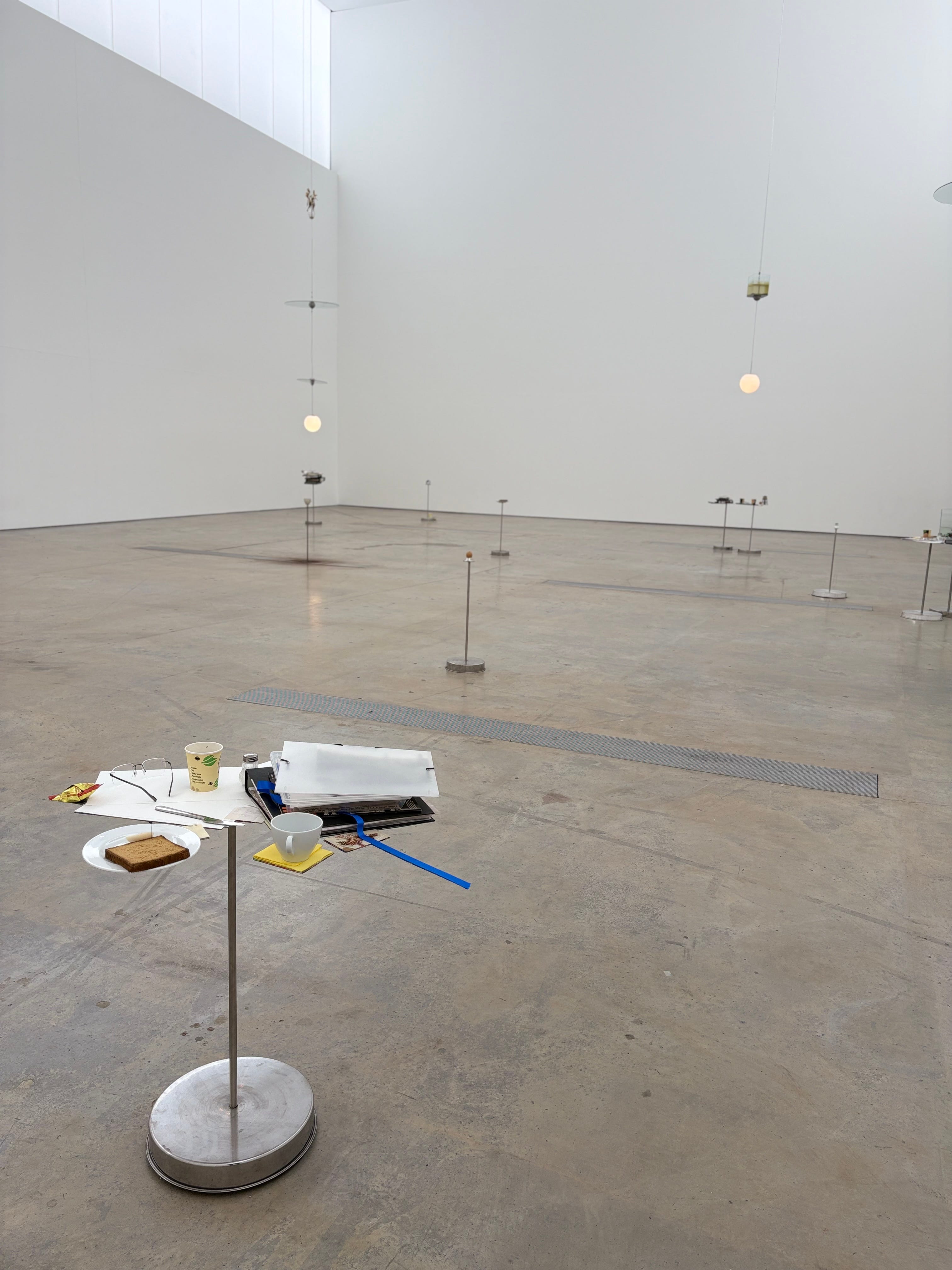
Andy Fitz’s Now, now is a novel installation, the best I’ve experienced at VISUAL, because it summons privacy, and with that, liberty. It’s all about entering a space that is sealed off from the rest of the world. That has always been the problem with VISUAL. Artists have always tried to stand up to its scale. And perhaps they were missing the problem. Perhaps it was VISUAL’s architectural openness to the external world, especially with the linked galleries that look out through those big panes of glass into that pond and beyond. But Fitz has done something different. At the side entrance to the main gallery—if we can call it that—they have barricaded the former floor-to-ceiling opening with sheets of timber almost seamlessly to reveal a new closed door. While the primary entrance—if we can call it that—is more deliberately staged, a corridor that leads to another door, a threshold into the main space, like a navel into the stomach.
The doors are interesting too because they have that, as mentioned in the press release, “utilitarian” aesthetic. They are purposeful in their aesthetic intention. Rounded metal handles, wipeable surfaces, what Marcel Duchamp called “the anaesthetic”—the refusal of aesthetic flourish, the coldness of the ready-made. And yet here there is a tension, between fact and feeling. Because while things appear first plucked from the world, they are often crafted to appear that way. Beyond the door that I pull shut tight behind me—I did feel like I should close the door behind me, not being raised in a barn but on entering one—I started to think of Robert Gober, who stages that same confusion, the deliberate slippage between what is real and what is made, what is found and what is constructed, what is cold and what is warm.
The entrance doors give mood and metaphor. They give a sense that you’re entering some kind of warehouse or impressive artist studio, or the fantasy of one. By placing these doors in and stitching the cesarean sections of the main galley, you feel like you’ve entered elsewhere. You’ve invaded an artist’s studio. An artist’s studio less about producing isolated objects to reconnect elsewhere, and more about holding things in suspension.
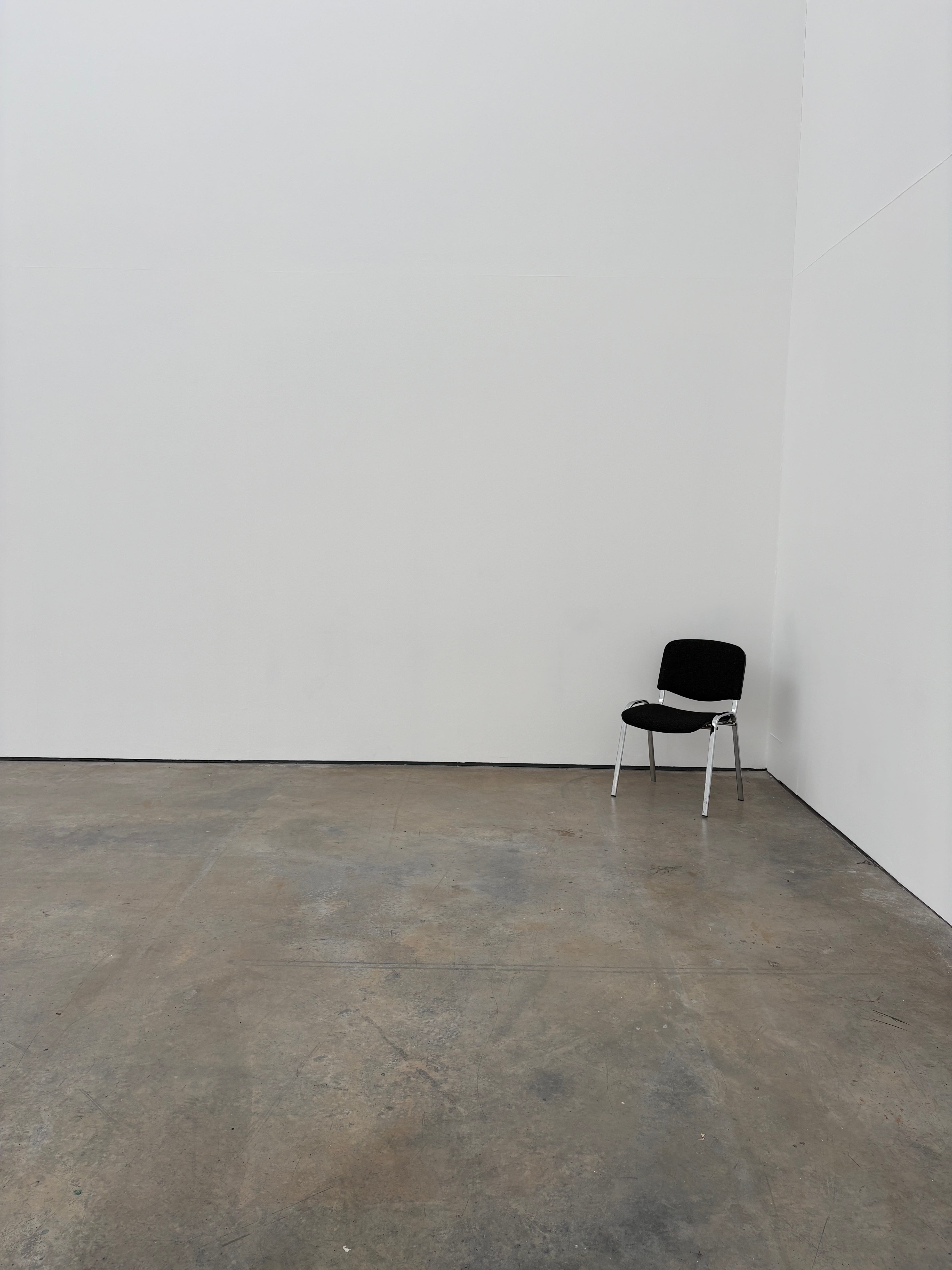
Initially, and for that matter for the duration, what haunts here is the empty invigilator’s chair that sits in one corner. No invigilator. This is key to this work, or my experience. I couldn’t take my eyes off it. When I entered, maybe through the wrong way, not the constructed “navel” of the gallery, but the side door, I was met by this chair and then the absence around it. I scanned the room. No one. And then I took a breath. Because it’s kind of great when you’re left alone in a gallery. It’s important. No one hovering, no imagined surveillance of your proximity to the work. There’s a liberty there… to not perform. And as I breathe it in, not just the air but the installation itself, there are objects hanging from the ceiling, others teetering on the tops of what I keep calling tables, though they feel more like stations, chrome structures from airports or cinemas for crowd control. It’s difficult to place, to name. There’s a planning, an ordering, sure. Sculptural elements that extend upward into the gallery space and downward again, suspended and grounded at once.
Some of these structures feel like towering vertical arrangements, but they are also delicate, tiered, almost like those afternoon tea stands, the stacked trays, tiered serving stands, where sandwiches sit on the bottom and sweets above, each level precariously balanced—I’ve never been to afternoon tea but I’ve heard. They hang from light cables, or rise from the stanchions, creating these vertical tensions, these lines of gravity that pull your eye up and down simultaneously. You’re constantly adjusting your focus, negotiating scale.
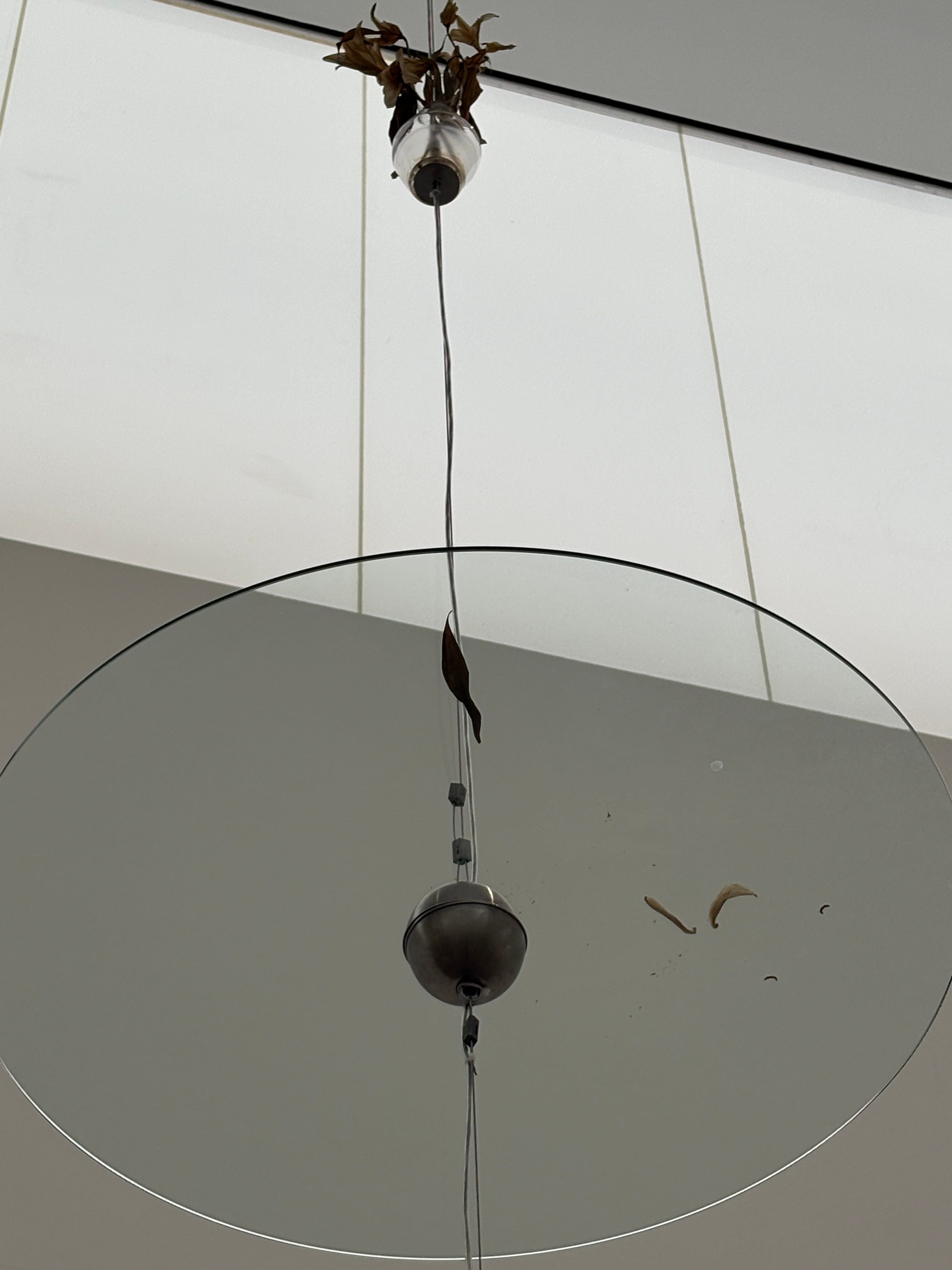
There are large round table-top panes of glass that catch the leaves of a withered plant on the top tier, the crow’s nest. There are spherical lights, the kind you might find in an American diner, hanging low into the space and eying the detritus below. Galleries use lighting to create intimacy or objectivity, but Fitz pushes this further, aestheticising the light itself, moving away from fluorescent or LED neutrality into something warmer, stranger. These globes interfere with the structures below, hovering just above notes, bits of paper, a scrunched-up Aldi throwaway brochure, a German newspaper hinting at the artist’s “Now, now” Berlin provenance, keys, fragments, things.
On one of these rails sits a catalogue of Caspar David Friedrich. A cigarette rests in a glass ashtray on top of it. And suddenly the register shifts. I start to think about the sublime, not as something distant and mountainous, but as something diffused through this space. The overcast quality of the building, the grey light, it echoes Friedrich’s atmospheres. That sense of looking into something you cannot fully grasp. And yet here it’s grounded in the everyday: the cigarette, the ash, the residue of time. The sublime is not transcendent here, it’s held.
There’s repetition too. These rising and falling structures, pushing and pulling at the height of the gallery—let’s call it a room from now on—echo one another. A rhythm, almost. A quiet insistence. And within that, these smaller gestures: the cigarette, the paper, the brochure, the catalogue. It’s as if history itself is being held and eroded at the same time. You don’t quite know if you’re looking at something preserved or something in the process of disappearing.
And those panes of glass bring to mind, almost without knowing why, that sculpture by Allen Jones, the kneeling figure bearing a glass surface on its back. I don’t arrive at it cleanly. It just appears. But what holds is not so much the controversy around it, but this idea of support, of a body made into structure, into surface, into something that carries weight. There’s something in that about oppression too, not as a fixed reading, but as a condition that produces form, the way hysteria was once understood as a symptom of pressures exerted upon the body. Here, objects carry, hold, balance, almost beyond their means. I notice the butterflies as well. Partly hidden beneath the German newspaper, or sheltered by it, contained within a glass case. There’s something here about beauty arrested, held in time, but also interfered with. A beauty that cannot escape its framing. Like the toast, the egg, the fly, things that suggest life, decay, process, but are fixed, suspended.
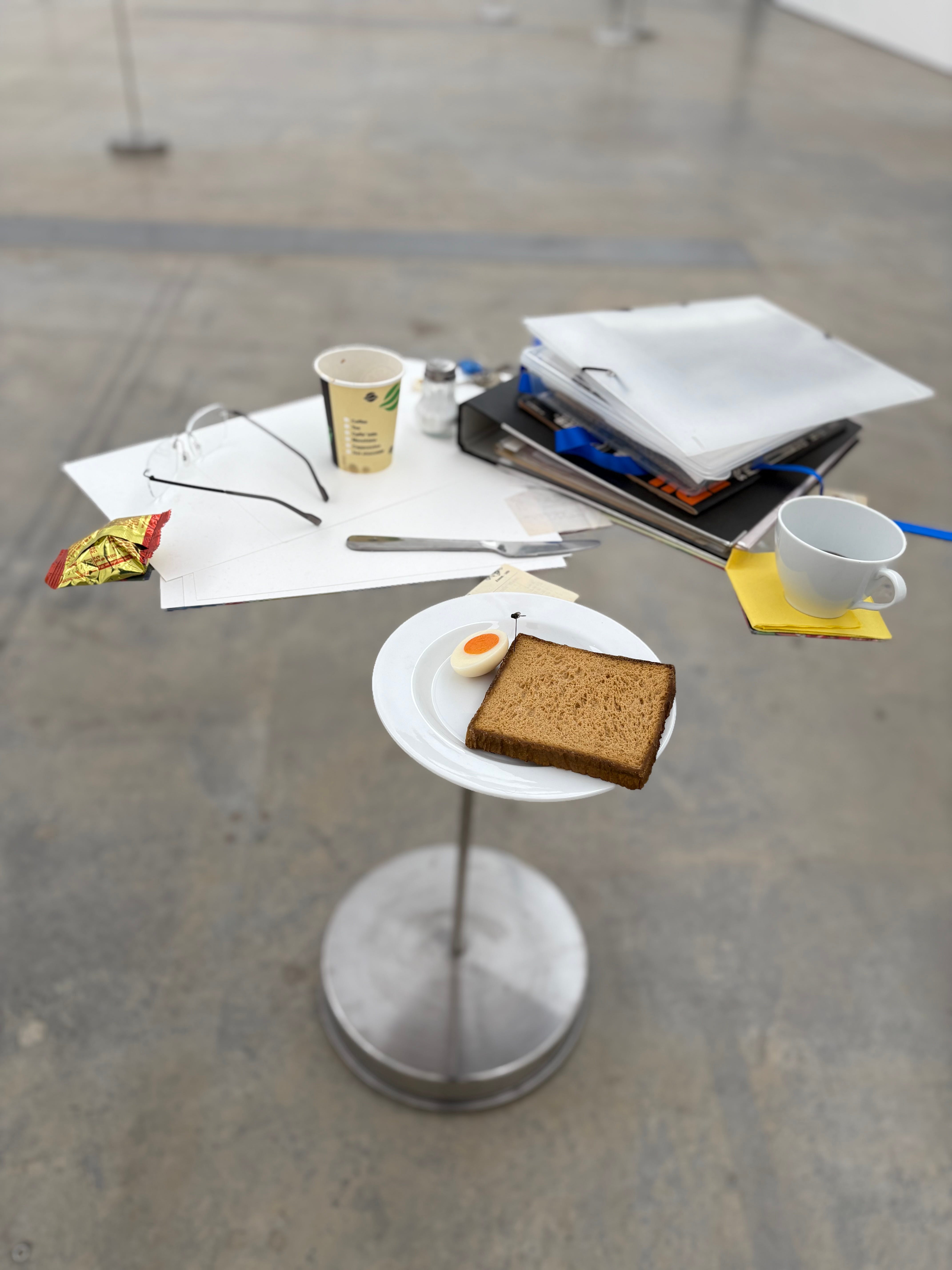
It’s not like Fitz’s earlier work. I’m thinking of the exhibition in the artist’s studio at Temple Bar Gallery in the late twenty-teens, where papier-mâché sculptures teetered in space, precarious, handmade. Here there is more elegance, less emphasis on awkward craft, at least on the surface, and more on the ready-made. But again, that tension persists. Things look anaesthetic, but they are often anything but. There’s a fly pinned in place. Glorious in its detail. Toast, eggs, things that suggest decay but resist it because they are fabricated. You’re caught between recognition and doubt. Between the real and its simulation.
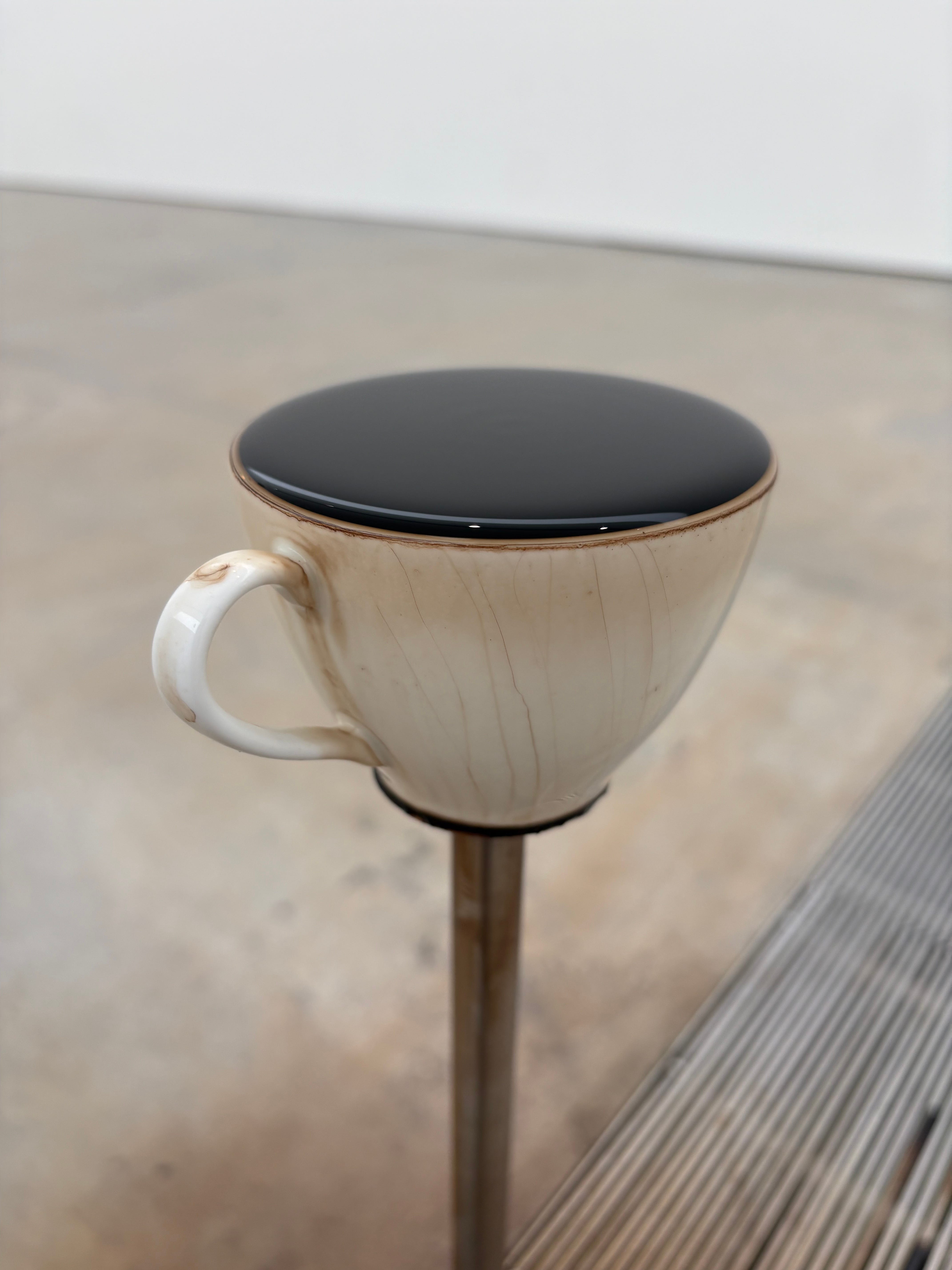
The spectacle, of course, is the motorised fountain (nod). A delicate round bottomed coffee mug with gold rim and craquelure—your best old China please—slowly fills, overflows, and spills into what now feels like the gallery’s drainage system but is probably ventilation. Satisfying. The floor stains accumulate, or perhaps they were always there. I begin to read the floor as part of the work, the residue as much as the object. Time is everywhere here. The cigarette sitting in the ashtray, still somehow warm in your imagination. The residue of burning, the evidence of time passing. The withering heights plant too, in its final week of the show, you wonder how much further it will decay. Whether the work changes day by day, hour by hour. There is a temporality that sits quietly within the installation, a stop-motion erosion.
When I try to take it all in, away from the detail, I feel privileged to be in a space that feels private. No one else enters. It’s like being invited into an artist’s studio before they arrive. Everything is in a state of testing, balancing, becoming. Papers scattered or placed, the plant caught in glass, the cigarette paused in time. There’s something about stillness here too. A stillness that grows more intense the further you step back. Like the aircraft carrier again, seen from a distance, where the sashay ocean movement stills into a painting. Everything held. Everything suspended.
And somewhere in that distance, in that shift between standing afar and standing inside, something else opens up, what Immanuel Kant might call the split between phenomenon (objects as we experience them in space, time and casualty) and noumenon (things in themselves minus us), what Arthur Schopenhauer reworks as will and representation, what Slavoj Žižek names the parallax gap. Distance and intimacy. Objectivity and subjectivity. The thing as it appears, the thing as it withdraws, alone.
Alone here, this privacy feels generous. Because it also feels like a work the artist might hesitate to show. Something provisional, intimate, unresolved. And yet here it is, on a grand scale, activating the coffee sewers below and empyrean above of this building that loses its presence. And I’m just thankful no one else was there with me to watch, to watch me looking, to watch me disappearing.
(Final week!) Through May 10, 2026.