The PMC
Artists as Workers; Curators as PMC

“Death is the dark backing a mirror needs if we are to see anything.”
—Saul Bellow, Humbolt’s Gift, 1975
My writing has taken on a sharper edge recently, a tone I haven’t inhabited since the old +billion- journal days, when plus and minus represented the polars of positive and negative critique, and “billion” the immediate context of the bank bailout in 2008, when I was still exhibiting and moving through the same white rooms I was writing about.
Back then the tension between being an artist and a critic produced a kind of vitality — bias, contradiction, and presence, the things institutional writing tries to clean away. Maybe that’s why Andrea Fraser has always been a touchstone. She embraces the contradiction of being both inside and against the institution, of being an artist who is also an institution. She shows that you cannot critique the system from the outside because the outside no longer exists.
Reading Catherine Liu’s Virtue Hoarders: The Case Against the Professional Managerial Class has reactivated that tension; although I am cautious of venturing too deep into the white-walled and papered Symbolic, leaving the poetic outside in the cold. Liu describes the Professional Managerial Class (PMC) as the class that manages, not produces; the class that redistributes elite wealth downward only to maintain hierarchy; the class that never gets hurt by its own work. The PMC is white-collar, credentialed, moralising, and salaried. They keep capitalism running smoothly by performing care while protecting their own position.
It hit me that this is the curator’s or art dealer’s class position in the artworld.
This isn’t an elaborate theory. It’s obvious once you see it. But I never saw it clearly when I was an exhibiting artist. I felt it, but couldn’t articulate it. Desperation disavows. My gratitude to curators directed my criticism inward no outward. They gave me opportunities. They noticed my work. They selected me. They arranged the space, the texts, the framing. They lifted my visibility. But the power dynamic was unmistakable: the curator was structurally above me, even if personally supportive. They were the ones who could say Yes. The artist is always asking.
I revisited this dynamic when walking through Atsushi Kaga’s show in the Douglas Hyde Gallery Dublin with students:
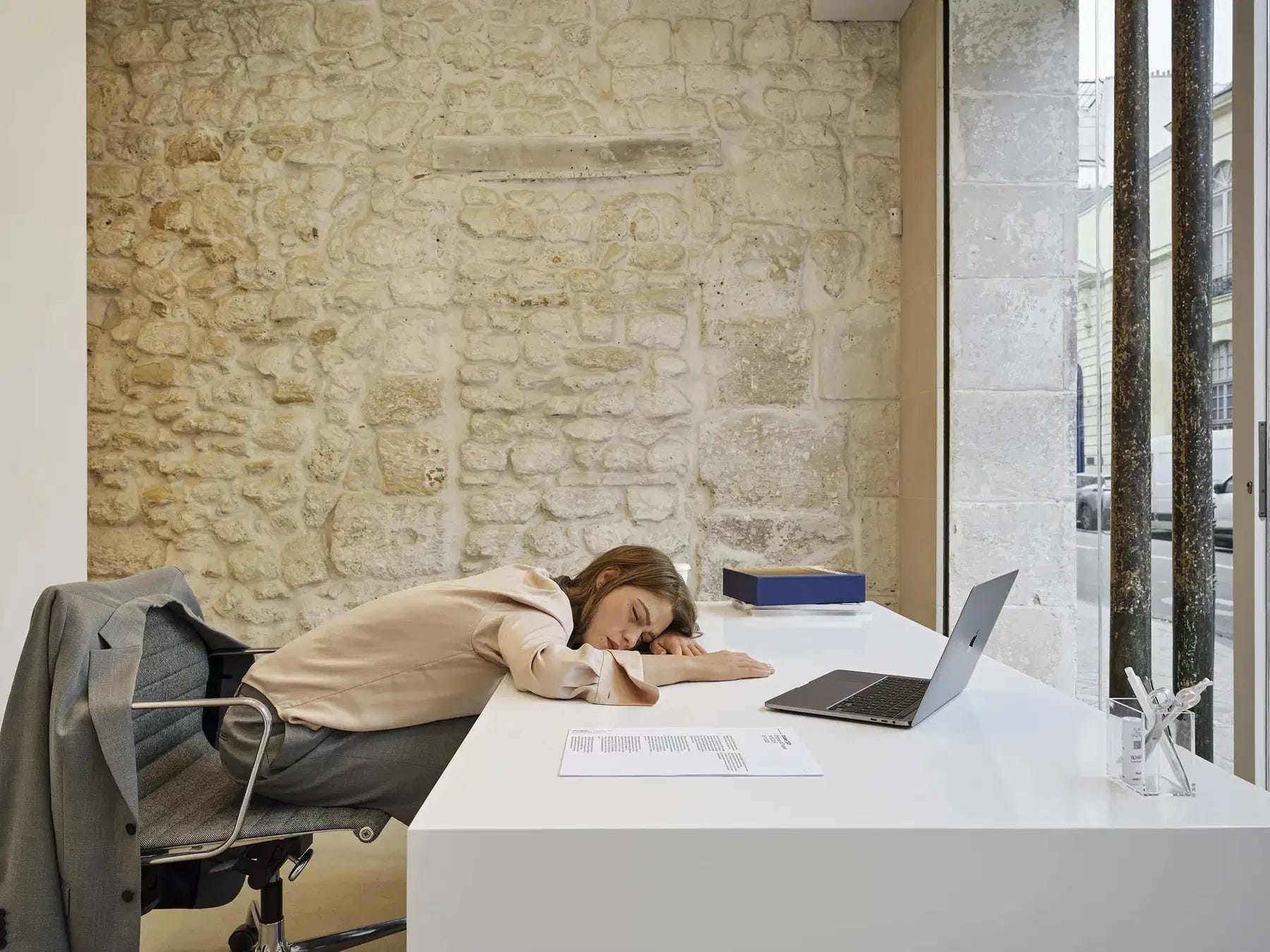
Kaga’s work stayed with me, but something else hit harder: four administrators sitting in a row above the gallery, piloting computers, heads down. The office was on view. Not glimpsed. Displayed. That visibility changed the experience of the exhibition. And I couldn’t help connecting it to a recent Elmgreen & Dragset exhibition in Paris, which opens with a small shock of recognition: a hyper-real gallery assistant slumped asleep at a desk. The artists apparently encountered a real assistant in this exact position and, instead of waking her, asked her to hold still for a photograph. That accidental moment — a worker caught between professional performance and bodily collapse — became the seed of the show.
The artists have also linked the figure to Ottessa Moshfegh’s My Year of Rest and Relaxation, where a gallery worker retreats into chemical hibernation because reality has become unbearable. It reframes the piece not as a joke about laziness, but as a study of burnout, of withdrawal, of a world demanding constant productivity while giving little back.
At Douglas Hyde, the administration wasn’t sculpted; it was simply there. Four terminals, four heads, four postures of administrative concentration. Emails going out, funding applications in progress, artist workshops being populated, PR lists being compiled, press releases drafted, RSVP and foot-traffic counters updated. All the unseen work that sustains the artworld made visible. Except it wasn’t work we could read. It was only an image of work: screens, wires, chairs, bodies. A tableau of administrative professionalism. Strangely, there are less exhibitions produced by Douglas Hyde these days.
I realised that the gallery’s administrative presence has become performative. Years ago, under the previous director John Hutchinson, you rarely saw the office. Invigilators were visible; administration was not. The gallery floated in that productive ambiguity where you knew work was happening somewhere, but you did not see the machinery. Now, the machinery is part of the display. The mirrors’ dark backing removed; the smoke lifted; the death roll of paperwork in motion (thank you to Saul Bellow for the line that inspired this:
Death is the dark backing a mirror needs if we are to see anything. —Saul Bellow, Humbolt’s Gift, 1975
This visibility is not neutral. It reframes the artwork. In a space where the artwork is passive, installed, finished, awaiting activation by viewers, the administration is active. The art hangs or sits quietly; the administrators type. The artist’s labour is in the past; the administrator’s labour is in the present. The artist’s sacrifice is invisible; the administrator’s productivity is on show.
Catherine Liu’s framework clarifies this:
If your work hurts you, you are not PMC.
If your work is managerial, coordinated, overseen, and salaried, you are PMC.
If your work sustains someone else’s profit or institution, you are PMC.
If you are tasked with managing or administering other people’s labour, you are PMC.
The curator and the arts administrator (curator’s and institutional bi-proxy productivity) fit this perfectly.
Meanwhile, the artist, by need or privilege, sacrifices money, time, identity, relationships, stability, and sometimes their future to produce the cultural object that the curator will later frame, contextualise, or extract value from. Even well-off artists pay to be artists: time, tuition, materials, rent, years of invisibility. Artists, regardless of background, occupy the structural position of workers. They make the thing the PMC manages.
And yet, these administrators could very well be artists dressed as the PMC. So are there layers to this class? If they are artists, like artist technicians who install the work of other artists in the gallery, it is a worse hell than the latter invisible activity. This is window dressing without performative and creative cache. Are these workers another layer of window dressing that represents an ever-expanding PMC under late capitalism?
This is clearer if you consider how hard it is for artists to inhabit administrative tasks. Artists resist funding applications, resist the curatorial hat, resist the managerial letter. Not out of laziness but because artmaking requires a different cognitive space: intuitive, pre-verbal, tactile. The PMC’s language of administration — of timelines, outcomes, frameworks, deliverables, actively conflicts with art-making.
This is why the PMC exists: to mediate between artists and institutions, between labour and capital, between making and presenting. But in mediating, they become the interpreters and arbiters of value. They take the critic’s job. They frame the work. They write the thematic logic. They decide the groupings; the group show being their currency. They speak the institutional language the artist cannot, and in doing so, they take the symbolic power by association.
In 2012, in my solo and final exhibition THELASTWORDSHOW at The LAB, I generated a simple stop-motion animation of a row of silhouetted curators, gallerists, directors, black shapes rotating, featureless. In the foreground, a headless chicken hopped frantically. That was me. That was the artist. Already selected, already grateful, already exhausted. I knew it would be my last show before our child was born. I knew I couldn’t sustain the sacrifice. I had paid , literally paid, to be an artist for twelve years, on the dole, in debt, no independent income. The public purse kept me afloat. I had no illusions about “career.” I had exhausted the urban and regional circuit.
My press release for THELASTWORDSHOW explicitly described the split:
James Merrigan has placed his two personas/professions in the gallery simultaneously. As an artist Merrigan is a Dr. Jekyll of sorts, having a similar ambition to bring forth the subliminal IT’ that lies just beneath the civilised collar of society. As an art critic he has been called polemical, but is most inspired by artists who lose themselves in the materials of their art making. The metaphor of Jekyll waking up to the damage ‘they’ inflicted on the public the night before is his best way of describing the aftermaths of both art making and art criticism.
THELASTWORDSHOW presents this fugue state of artist and art critic as text light-boxes, video, sculpture, sound. Merrigan’s art practice is left wide open to oohs and aarghs with his blatant use of art world generalities, clichés and reductive puns - along with a few uncanny moments that somehow snaked their way in when the critic was sound asleep (or awake?) - the artist doesn’t remember.
What strikes me now is that the PMC never exhausts itself the same way. They migrate from institution to institution. They retain their salary, their titles, their networks, their associations. Their productivity is constant, even when nothing is being produced. The artist’s productivity must be a conveyor belt to be visible; the curator’s productivity is visible even when nothing emerges, except for the next emerging artist.
This is why the four backs of the desktop computers at Douglas Hyde matter. They embody the contradiction Liu identifies: the PMC must appear productive to justify its role in managing the labour of others. This appearance becomes a spectacle: “Look, we are working.” And in that performance, they eclipse the labour that matters: the labour on the walls, the labour in the material, the labour that hurt someone to make.
This is not resentment. It is description.
The artworld runs on the PMC. The curator has taken the critic’s authority, the administrator has taken the curator’s invisibility, and the artist is asked to remain grateful. Without the PMC, the artworld collapses, not because art disappears, but because the infrastructure does. But without artists, the PMC has nothing to manage, no content to organise, no exhibitions to frame, nowhere to aim their emails.
The class dynamic is stark:
Artists produce.
Curators administer.
Institutions stabilise.
PMC performs visibility.
Artist vulnerability is constant.
The backs of four computers in the Douglas Hyde are the new proscenium. The drama is administrative. The performance is managerial.
This polemic isn’t a call for abolition. It’s a call for clarity: to see the class structure we inhabit, and to recognise the labour that gets hidden, the labour that gets displayed, and the labour that gets managed into silence.
.
That is a lovely quote! I often wondered when you mentioned you stopped being an exhibiting artist whether you missed it? Being the chosen chicken…
How and where do art teachers fit into the art world?